Older than the first dynasties of Egypt. It works. There is a reason nobody told you about it.
I arrived there with a debt I couldn't say out loud. I left four years later without it, and with two businesses of my own. What changed wasn't my circumstances. It was what I think with.
Eight years ago I stood in a shop counting coins in my hand. I put back on the shelf the thing I'd picked up for myself. The children kept everything.
My husband was gone. What was left was a debt in both our names that I found out about from the bank. And eight months in which nobody came. Not my mother, not my friends, not the state.
Then I took the only work I could take with a six-year gap in my CV and no qualifications. House help. Cleaning, cooking, collecting things from the dry cleaner.
Old money. Not yachts — quiet, books, three generations at one table. I watched them every day and saw things I couldn't explain.
They don't worry. At all. A deal that fell through gets the same tone as the weather.
They don't complain. Not once, not about anything, not about anyone.
They talk about what things do to a person, not about the things.
Children at that table get asked questions the adults in my world can't answer.
It was never about the money. The money was downstream. That took me about two years to see.
And there was a room in that house with books you don't find in shops.
I was dusting in there and one day I opened one. Later I asked a question at dinner. He didn't answer then — he answered the next day. He said: a lot of people have worked here over twenty years. You're the first one who asked.
Then came four years.
The debt was gone in the third. Not by a miracle and not by luck — through a chain of openings, every one of which the old me would have walked straight past. They'd been there before. I wasn't the person who sees them.
You've heard of the Masons. Skull and Bones. The Bilderberg Group.
You were allowed to hear about those. That's what they're for. What actually runs things has no name, no website, no documentary.
The foundation under it isn't their invention. It's far older.
It's older than the first dynasties of Egypt. The first written records of it are more than four thousand years old — and even then it was written down as something long known, not as a discovery. Everything you can find on your own today is a late retelling. The line as within, so without has been copied for eighteen centuries, and it was already a retelling of something earlier.
These texts were never banned. They never needed to be. They simply ended up where an ordinary person doesn't go: in languages he didn't read, in houses he wasn't invited into, with people who don't explain. What was left for everyone else was the simpler version. Work hard. Be good. Wait your turn.
There was no secret meeting where they decided to keep you out. There was something more reliable than that. It was passed at the table, to their own children, and to nobody else — and for thousands of years that was enough.
The people who made the decisions for everybody else. I won't give you names — I gave my word, and it's the one thing I carried out of that house intact. I'll say it another way instead: look at which families are still standing in the third and fourth generation, and ask yourself what gets taught at their dinner table. Money doesn't last four generations by itself. Money without what people do with it in their heads is gone in one — you can watch that happen to anyone who wins a lottery.
Not because it's dangerous, and not out of malice. An advantage everybody has stops being an advantage. That's the whole reason. It's so simple it's hard to believe until you've watched it from the inside.
It didn't stay closed because of oaths. It stayed closed because it could only be handed over close up — at a table, one piece at a time, to someone you see every day and test for four years. For thousands of years that was enough.
It isn't now. A person can be taught by someone they never meet. The wall that stood for four thousand years stood on distance, and distance no longer exists.
So it's coming out of those houses. It has been for years — in pieces, in fragments, usually mangled, because the ones who carry it out are usually the ones who didn't finish learning it. The only question now is whether it reaches you whole, in an order you can actually follow — or as one more fragment that changes nothing.
People with crystals are usually the ones talking about ages turning, which is why a sensible person waves it off. Don't. There's astronomy under it, not mood.
The earth's axis wobbles. Because of it the spring equinox point slides around the circle of constellations, taking roughly two thousand years to cross one stretch of it. It's measured with instruments and it doesn't care what you believe. The tradition all of this comes from counted time exactly that way — and the other half of its central line reads as above, so below. That isn't poetry. It's correspondence.
On that count every age has a character, and what goes under cover in one comes out in the open in another. The one we've entered is about the distributed. About the many instead of the few. About things that stop having a single owner. When exactly it started is argued over. That we're in it, almost nobody argues.
That's the whole answer to why this is surfacing now and not a century ago. From above they call it an age turning. From below it looks like distance no longer existing. It's one event.
You don't have to believe any of it. You only have to notice that it's happening.
The time has come when this stops being the property of a few families. Not because they softened. Because it can't be held any more.
I gave my word I'd never name that circle. I never gave my word not to teach you what they taught me.
There are two scales, and everything depends on them. I was measured on both in my first week, and I still think it was the most honest thing anyone did to me there.
The first is willingness to learn. Nearly everyone rates themselves high here, and nearly everyone is right. You wouldn't be reading this otherwise.
The second is willingness to be changed. And this is where almost everybody ends.
You can be completely open to something new and completely unwilling to let it alter how you live. The words that take the second scale to zero in one second: I know that already. Said once, they close the subject for good — because knowing a thing and being changed by it are two different events, and most people's whole lives fit in the gap between them.
You'll be given simple things here. Some of them will look too simple. The first task I was given looked like mockery, and I decided they were laughing at me.
If you've caught yourself thinking I know that already twice while reading this page — don't buy it. Nothing will come of it, and it won't be the method's fault.
Not your mood. Not your productivity. Not your outlook.
What changes is what you consider normal for yourself. That's the only thing that matters, because normal is what belief is made of, and belief decides which openings you notice at all, what you'll go after, and what you'll rule out before you've finished thinking.
Money is not an awkward subject here. The opposite. It's the first of four areas you write about from day one: money, work, people, body. The first task is four sentences on where you actually stand in each, plain facts, no explanations and no whose-fault-it-is. Most people have never written those four sentences once in their lives.
After that you do three things at once, every day, for ninety days.
There's one instrument here: your state, a number from one to ten, twice a day. A flattering seven is worse than a missed day — it's the one place where a lie corrupts everything downstream of it.
This is where nearly everyone goes wrong. You're told to reach straight for the good thing. From a flat state nothing reaches, and people hold a beautiful picture for years with no pull behind it. Meanwhile their worry works perfectly — because worry is goal-setting in reverse: you already know how to rehearse the unwanted in fine detail and with full feeling. Here you turn that same skill around. So the morning starts with twenty seconds in which you bring up what you will no longer tolerate and let yourself feel it completely. Not complain about it. Feel it. Energy contracts. And from that peak you turn into what you want. The contraction is the launch. Almost nobody teaches it, and it works.
You want it, and a quiet part of you answers not for you, every time. The two signals destroy each other, and what's left is a strain people mistake for effort for years. So the aim here isn't raised higher. It's shrunk until you actually believe it, and then climbed in steps — each one standing on the fact that the last one turned out to be true.
Ninety days isn't a round number chosen for looks. A single practice takes about a month to stop costing effort, and there are three of them here, laid in layers.
A truth heard once is information. The same truth met for the tenth time, each time on a day that demonstrates it, stops being something you remember and becomes something you think with.
That's why a law stands at the top of every screen. For ninety days.
It's how I was taught. A piece at a time, and the next one only after the last had become a habit. Not after I understood it. Understanding doesn't count as a result here.
About six minutes in the morning and six in the evening.
State — a slider from one to ten. Three seconds, no thinking.
The law of the day — one line in large type: the principle today stands on. Under it a short paragraph: what you're about to do, why it follows, and how you'll know it worked.
Today's task — one concrete thing, in the real world.
The contraction — twenty seconds. The timer is hard: once you begin, the screen moves on by itself and there's no staying longer.
The turn — one line, out loud where you can: and what I want instead is — and your aim.
The hold — ninety seconds. You hold the aim as already true.
The release — exhale, unclench, put it down.
State again — the same slider, after the release.
Appreciation — one line.
State. Anything that arrived today connected to what you want — a thought, a person, an offer, a coincidence, the thing itself. Did you do today's task: yes, partly, no. No is a normal answer and it's data too. One line of what you noticed.
The sit can't be skipped. Everything else in the day records what happened; that's the one place where something is done.
The ring — twelve daily habits, one tap each. None of it is required and none of it blocks the day. The point is elsewhere: completion is plotted on the same axes as your state line, and within a few weeks you find out which of the twelve moves your number. It's different for everyone.
The week's assignment — one piece of work a week that can't be done at a desk. Go and stand next to the thing you want. Sit in that car. Walk through that flat. Spend real time near someone who already has it, and write one line: what they do that you don't. Give something of value away and say nothing about it. Spend half an hour looking at lives that currently seem impossible to you. Those are the things that move what a person treats as normal — and normal is what belief is made of.
Tools, always within reach. Your own list of what reliably lifts you, which opens by itself whenever you log a four or below. The reset — a two-minute sequence for when a feeling won't move. The cancel counter: catch a thought, replace it, tap. The physiology card — four lines, four seconds.
The sweet spot — desire and belief on one square. Below eight on belief and the aim gets shrunk and re-rated.
The belief ladder — rungs from what you already believe up to what you don't.
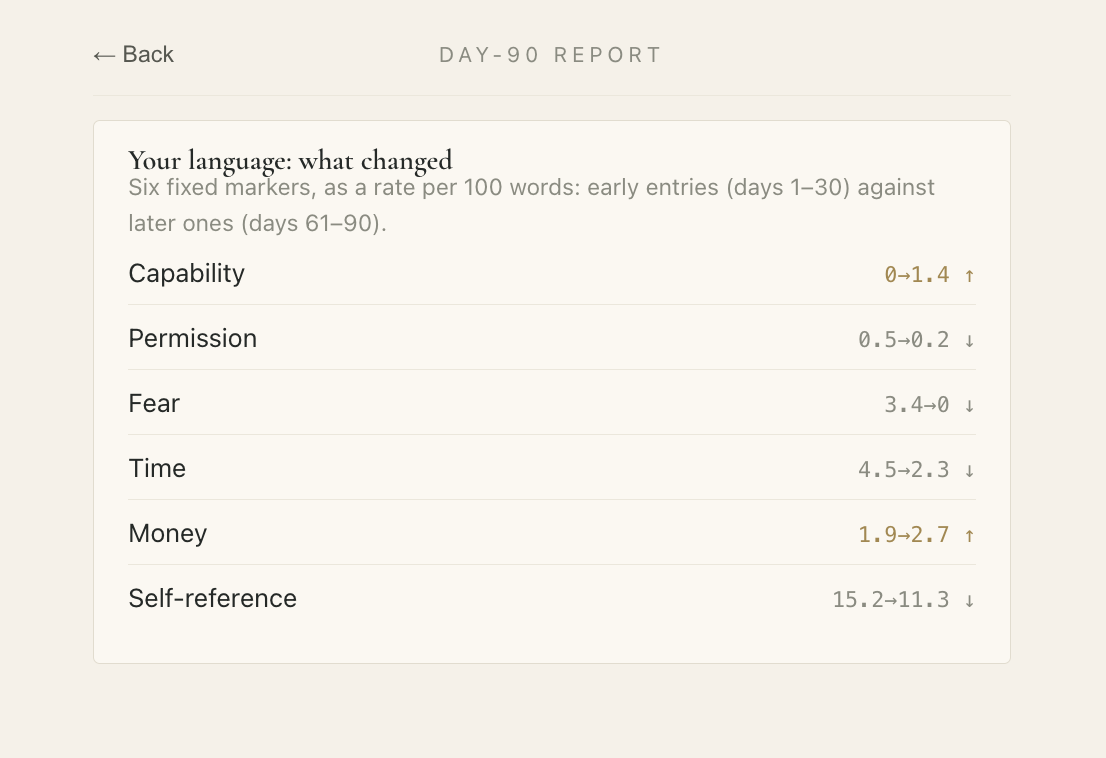
The mirror — your own writing, counted. How six markers in your language shifted between the first month and the last: capability, permission, fear, time, money, and how often you refer to yourself. Nothing is interpreted. Only counted. Words change before circumstances do — usually before the person notices.
The twelve and the ten. Out of those same texts: twelve things that hold a person down, and ten that displace them. Not a list of vices — an inventory of states, named individually thousands of years ago, and named more precisely than modern language manages. Open from day one, nothing to earn.
The gates on day 30 and day 60. A check against your own data. Not a punishment: what comes next is built on what came before and won't stand without it.
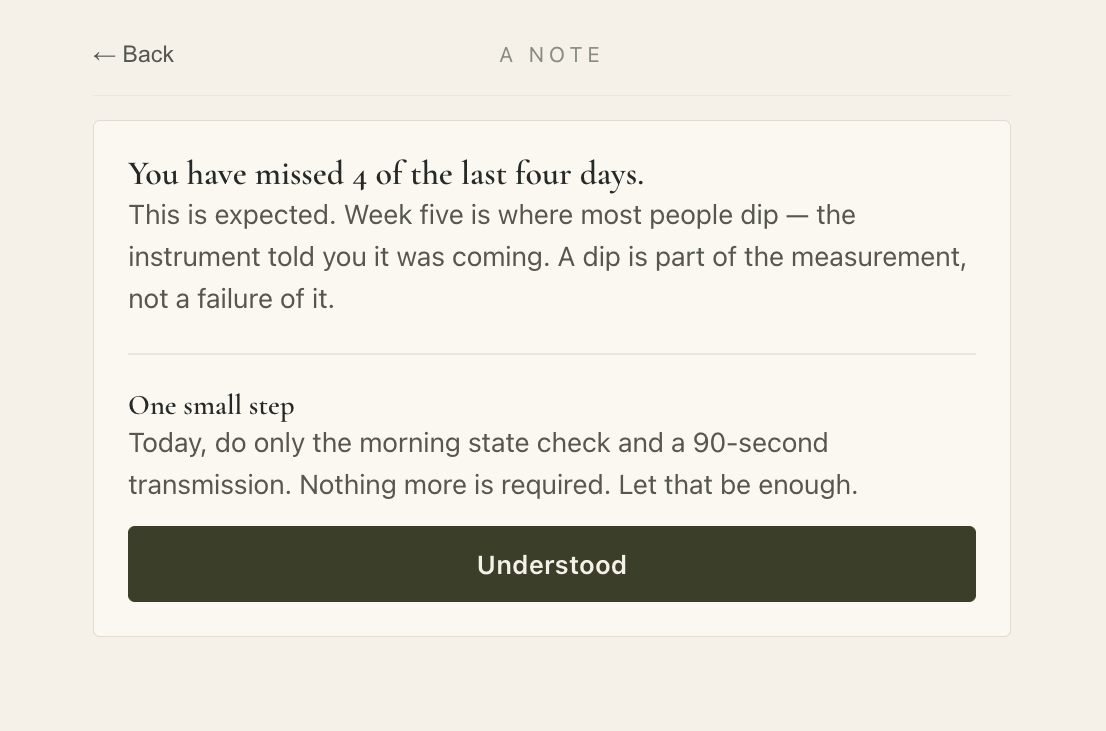
The downswing module. It appears on its own when your numbers say you've dropped. It tells you plainly that this is the swing you were warned about on day thirty-seven, not a failure of the method — and then it shrinks the day to almost nothing. One state check and ninety seconds. That's enough for today. This is where most people quit, and they quit because a flat fortnight feels like a verdict.
I'm saying that without hedging and without possibly. These principles are more than four thousand years old. Thousands of people have run them before you, and they worked for every one of them who ran them properly — because they aren't about luck or character, they're about how a person is built. They worked on me, and I was the worst candidate you could design: no education, no money, two children, and a debt I found out about from the bank.
They'll work for you too.
But.
They work the way a course of medicine works when you have to finish it. Not because somebody strict decided so, but because that's how the thing is built. Skip half and you don't get half the result. You get nothing, and then you're certain you were cheated.
So what follows comes in two parts and has to be read together. First what I promise. Immediately after it, on what condition.
The principles aren't mine. I didn't invent them and I didn't improve them. They're older than the first dynasties of Egypt, and there's nothing in them to touch.
What's mine is the order.
None of this was ever behind a lock. It was scattered — through texts an ordinary person won't open; through books where the thing you need sits on page three hundred mixed in with what you don't; through people who pass it on by mouth and only to their own. Access was never the problem. The problem is that in that state it can't be done. You can read it, be impressed by it, and a week later not know where to start.
I was taught for four years, and it only worked because a living person stood next to me: gave me one piece, withheld the next until the last had become a habit, and tested me without warning. Without him I'd have got nowhere. That person is exactly what almost nobody has.
I've put the same thing into something that works without him. Ninety days. One day is one principle, one action that comes out of it, and a check on whether you did it. Nothing to search for, nothing to decide for yourself, no skipping ahead and no reading the ending.
You aren't paying for the knowledge. The knowledge is older than all of us. You're paying for the order it can be done in, and for something standing next to you every morning that won't let you skip.
I'm not promising you a figure. There are no figures on this page.
I'm promising you a different person at the moment of deciding. It's the only thing anyone can actually give you, and the only thing everything else grows out of.
Specifically — here's what will be true by day ninety.
You'll stop waiting. I waited eight months for the cavalry. It never came for me and it has never come for anyone I know. This one goes first and it's visible from outside.
The thing holding you in place will have a name. Not "low confidence" and not "bad luck" — a specific sentence you say to yourself, and whoever you first heard it from. Once named, a thing stops running by itself. The whole second month stands on this.
You'll start seeing what has been lying next to you the whole time. There's nothing mystical in it: attention is selective, and its setting moves with what you consider possible for yourself. My debt wasn't closed by miracles. It was closed by four or five openings, every one of them in plain sight, and the old me would have walked past every one.
Decisions will stop costing you weeks. In that house a deal that fell through got the same tone as the weather. For two years I thought that was breeding. It isn't breeding. It's trained, and it trains faster than you'd expect.
And you'll know what moves your own number. Which of the twelve, at what time of day, what after what. Not out of a book and not out of someone else's experience — out of ninety days of your own readings. You can work with that for the rest of your life, and nobody will ever be able to sell it to you again.
Money isn't a separate line on that list, deliberately. It sits downstream — behind what you notice, what you ask for, and what you rule out before you've finished thinking. In that family the money was downstream. It took me two years to believe it.
This is more than four thousand years old, and all that time it was passed to their own children. Thousands of people have lived whole lives by it and built things that are still standing. Nobody hands their children something that doesn't work. Nobody spends four years of their own life on it, or asks for your word to stay quiet about it.
I watched three generations at one table. The difference between them and my old life wasn't luck and it wasn't starting capital. It was how they think, and it showed in every small thing: what tone they use for a failure, what they ask their children, what they never do.
What I don't have is a thousand testimonials. I opened this room recently, and I'm not going to show you other people's faces and other people's figures. The moment someone starts showing you receipts, receipts are what they're selling. Instead I'm showing you how the whole thing is built, in advance — and giving you ninety days to get your own evidence instead of somebody else's.

Everything above applies to a person who met two conditions. Not one. Both.
Ninety days. Not "roughly" and not "mostly". The way it's written: both sessions, the sit every morning, the week's assignment, the gates passed on real data, and not one entry written after the fact.
It isn't my conscience that counts this. It's the app. On day ninety your report carries a number: how much of the method you actually ran. Not a feeling. A number.
That's why the sit can't be skipped and yesterday can't be filled in. Not out of strictness: lie to the instrument once and it starts lying to you, and you don't have another one.
The gates on day thirty and day sixty exist for exactly this. They don't punish. They show whether you were really doing it — and what comes after is built on what came before.
I was tested without warning for four years. A question in the car on the school run. A task for a month that was never mentioned again until I reported on it myself. Not once was I told I'd done well. I took it for coldness at the time. It was the only form of respect that existed in that house: nobody handled me gently, because nobody thought I was someone who needed handling.
If you ran less than seventy per cent, the method wasn't tested. You were, and you already know the result.
That's the second scale, and here it comes back not as a question but as a requirement.
You can do all of it and change nothing. A person fills in ninety days neatly, ticks every box, never misses once — and stays exactly who he was, because every morning he answers I know that already on the inside and does the whole thing while letting nothing in. I watched myself do it for a year. On paper I was doing the work. In fact I was holding a line.
What letting it in looks like:
When you're told to shrink the aim because you don't believe it — shrink it. Don't explain to yourself why your case is different.
When a task looks too simple — do it, instead of deciding you're above it.
When an uncomfortable week's assignment arrives — go and stand next to the thing you want, and sit with how awkward that is. The awkwardness is the content of the exercise.
When something you didn't know about yourself comes up in the report — don't argue with the number.
And this shows too. Not on your word. Whether you shrank the aim when belief fell below eight, or left it where it was every time. How the six markers in your language moved between the first month and the last. How many times the answer to the day's task was no. The person who did the work without letting it in can see that in his own report as clearly as the one who skipped days.
If you do all ninety days — and the app will confirm it — and on day ninety you look at your own lines and see that nothing moved, write to me. I'll refund it in full.
Not after thirty days. After ninety, when you've done all of it.
I don't want your money if it didn't work for you.
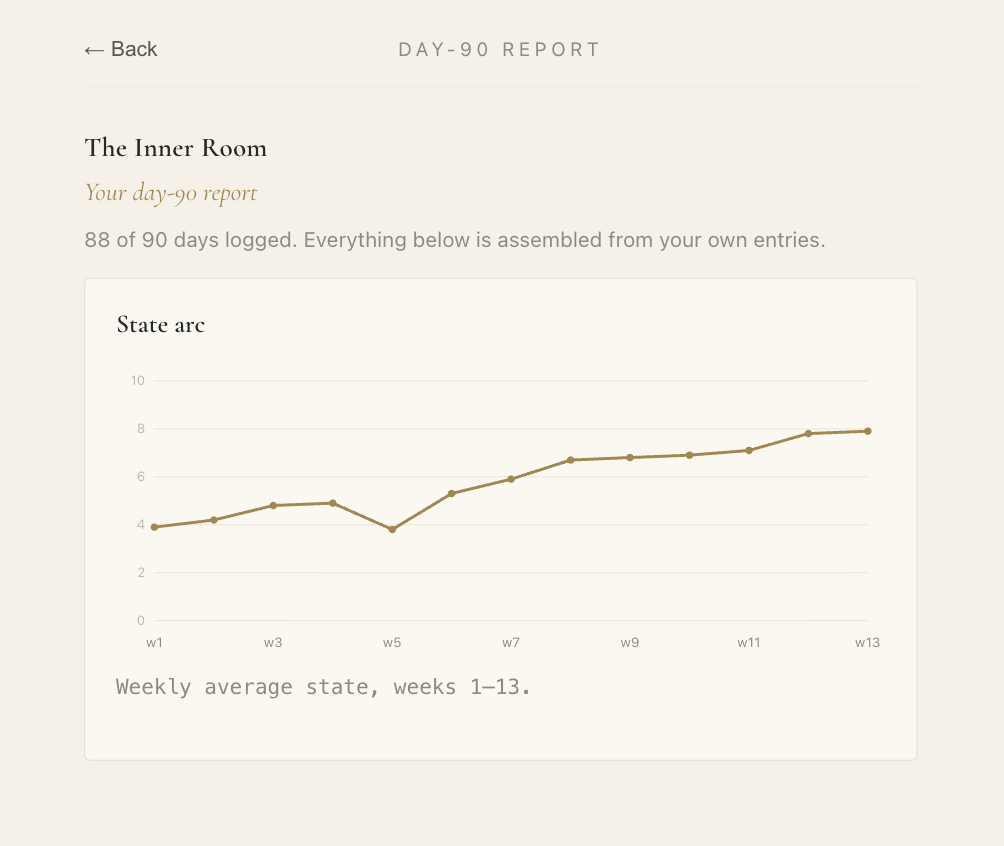
What it'll be measured against. A one-page report, exportable as a PDF. Your state line by week. Arrivals on the same axes. The before-and-after pair for the practice itself, averaged over ninety repetitions. Task completion and ring completion. Every aim you set and every step-down you made, with dates. The six language markers, early against late. And your own answer to who am I to want this from day six, set beside your own answer from day ninety.
Nobody is asking you to believe. Readings are being taken from you.
Foundation — about ten minutes a day. This is the whole method.
Deep — adds a written prompt, a longer hold and a daily reading. Thirty to forty minutes.
Deep isn't better. The one you'll actually do is better. You can switch on day thirty and day sixty, and only there.
No chat, no community, no calls. No coach. No subscription — one payment, ninety days. No motivation: not one line here congratulates you for showing up.
And you won't be praised for what you complete. In four years nobody praised me once, and it turned out to be an important part of it rather than rudeness.
I don't name my own figures. Not here, not in anything I post, ever. The moment someone starts showing you receipts, receipts are what they're selling.
$49 now. When the first hundred people are in — $79.
I'm not putting a timer on it. It'll simply end.
One payment. Ninety days.
Entry is by code. There's nothing to create: no password, no profile. Your email is needed once, at payment, so the code and the entry link can reach you; it isn't connected to anything you write inside. The code works on any device, and it's the only key — lose both the code and the email and you can write to us: we'll find your payment and send it again.
Thirty days — if you've changed your mind. Day thirty is the first gate, the end of the first part: run it, look at your numbers, decide it isn't for you, write to me and I'll return it. No explanation needed.
Ninety days — if you did all of it and nothing moved. Conditions in sections 10 and 11. That one is harder to earn, and it's the only one that means anything to me.
No. The records that reached us are hermetic — eighteen centuries old, and in the public domain; the tradition they're retelling is far older and goes back into Egypt before the first dynasties. There's nothing to believe in and nothing to join. The tradition counts time astrologically and I say so plainly, but not one task in these ninety days asks you to believe in that: everything you'll be doing is done to you, not to the stars.
Because books have the knowledge and this has the order. They're different things, and it's usually the second one people are missing. I'd read the same material and did nothing with it for years — until someone stood next to me who handed it over one piece at a time, withheld the next until the last had become a habit, and checked. This is what I built in place of him. The texts it all comes from are in the public domain; I name them plainly and I'm hiding nothing.
A missed day breaks nothing. Log the next one. You can't fill in yesterday: written from memory it isn't a reading any more.
No. You need to agree to test it. The instrument measures you, not your faith.
Money is one of the four areas and it isn't avoided here. But the work isn't done on money. It's done on what you consider possible for yourself, and money sits downstream of that. In that family the money was downstream, and it took me two years to believe it.
Look at your arrivals log rather than your impression: almost everyone records less than actually happens in the first fortnight and then remembers the month as empty. And ninety days is the length precisely because results in this work are usually late rather than absent.
I guarantee that it works, and I back that with money: do all ninety days, get nothing, and I return all of it. What I can't guarantee is that you'll do it. That's the one part that isn't in my hands, and it's the whole of it. Nobody promised me anything either. I've come to think it wouldn't have worked otherwise.
They gave it to me one piece at a time, over four years, and tested me before each next one.
I've put the same thing in order, into ninety days.
The rest you can work out.